Showing posts with label History. Show all posts

Monday, April 2, 2012

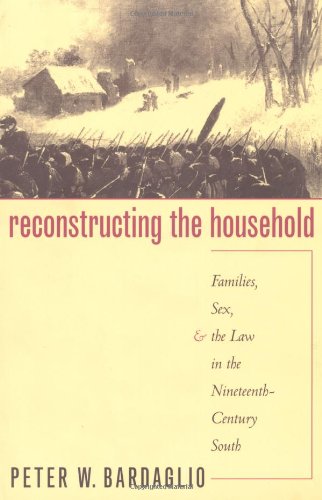
Reconstructing the Household: Families, Sex, and the Law in the Nineteenth-Century South (Studies in Legal History)

Reconstructing the Household: Families, Sex, and the Law in the Nineteenth-Century South (Studies in Legal History) Review

See more picture


In Reconstructing the Household, Peter Bardaglio examines the connections between race, gender, sexuality, and the law in the nineteenth-century South. He focuses on miscegenation, rape, incest, child custody, and adoption laws to show how southerners struggled with the conflicts and stresses that surfaced within their own households and in the larger society during the Civil War era. Based on literary as well as legal sources, Bardaglio's analysis reveals how legal contests involving African Americans, women, children, and the poor led to a rethinking of families, sexuality, and the social order.

Before the Civil War, a distinctive variation of republicanism, based primarily on hierarchy and dependence, characterized southern domestic relations. This organic ideal of the household and its power structure differed significantly from domestic law in the North, which tended to emphasize individual rights and contractual obligations. The defeat of the Confederacy, emancipation, and economic change transformed family law and the governance of sexuality in the South and allowed an unprecedented intrusion of the state into private life. But Bardaglio argues that despite these profound social changes, a preoccupation with traditional notions of gender and race continued to shape southern legal attitudes.


Check price now


Rerate Products


Customer Review


Apr 02, 2012 15:23:07

Friday, March 2, 2012

Family and Household in Medieval England (Social History in Perspective)

Family and Household in Medieval England (Social History in Perspective) Review


See more picture


Family and Household in Medieval England discusses the history of family life in England from c. 1066 to c. 1530, drawing upon both primary sources and a wide range of secondary literature. After a discussion of the family in theory and law from late classical times, the book traces the development of the family in this period by following a "life-cycle" approach, from marriage, through childbirth, to the dissolution of marriage by death or separation.


Check price now


Rerate Products


Customer Review


Mar 03, 2012 01:57:05

Thursday, March 1, 2012

The Holy Household: Women and Morals in Reformation Augsburg (Oxford Studies in Social History)

The Holy Household: Women and Morals in Reformation Augsburg (Oxford Studies in Social History) Review


See more picture


This is a fascinating study of the impact of the Reformation idea of "civic righteousness" on the position of women in Augsburg. Roper argues that its development, both as a religious credo and as a social movement, must be understood in terms of gender. Until now the effects of the Reformation on women have been viewed as largely beneficial--Protestantism being linked with the forces of progressivism, individualism, and modernization. Roper here argues that such a view of the Reformation's legacy is a profound misreading, and that the status of women was, in fact, worsened by the Reformation. A number of themes are explored: the economic position of women in the household economy; the nature of "civic righteousness" and how it applied a "reform moralism" to the role of marriage and the household; the efforts of civic authority to reform sexual deviance; the attempts to control marriage and the breakdown of marriage; and the role of convents and nuns. The Holy Household is the first scholarly account of how the Reformation affected half of society. It combines sound application of feminist theory with careful, open-ended archival research to advance our understanding of the Reformation, of feminist history, and of the place of women in modern European society.


Check price now


Rerate Products


Customer Review


Mar 01, 2012 20:22:34

Thursday, February 2, 2012

A History of Household Government in America

A History of Household Government in America Review


See more picture


What is household government? To the vast majority of those living in America from the seventeenth to the mid-nineteenth century it was the government. The head of a household, invariably an adult male, had authority over the property, labor, and mobility of not only his minor children but also his wife, servants, slaves, and the occasional debtors, indigents, or orphans the county paid him to board in the absence of institutional facilities.

A History of Household Government in America tells the story of the seldom noted expansion and then dramatic contraction in household authority and the effects these changes had on the governmental system. The disintegration of household powers during the mid-nineteenth century -- the household's "civil war" -- is much more central to what makes that period seem modern than industrialization or urbanization.

Carole Shammas offers new explanations for why the American household head became such an early victim of household egalitarianism. Previous theories involving the frontier or the Revolution have ignored other factors unique to the American household system such as testamentary freedom, weak lineage controls, and the lack of an established church, all of which left the head vulnerable to challenges by dependents. These factors also affected the development of social services: In the United States, public and private welfare agencies originated largely out of concerns about the adequacy of household management and discipline. Religious rivalries eventually forced a partial return to household solutions through a welfare state system. That history helps explain why even today any departure from heterosexual two-parent family units continues to be viewed as dysfunctional by a significant portion of the population.


Check price now


Rerate Products


Customer Review


Feb 02, 2012 11:37:05

Friday, January 20, 2012

Poverty, Female-Headed Households, and Sustainable Economic Development (Contributions in Economics and Economic History)

Poverty, Female-Headed Households, and Sustainable Economic Development (Contributions in Economics and Economic History) Review


See more picture


This book examines female-headed households (FHHs) in the world economy, aspects of their poverty, and the implications of those for sustainable development. Following a general discussion of FHHs in the world community, the work discusses FHHs in two regions of India, one being an example of unsuccesssful development and the other of successful development. The research is based on fieldwork in five rural villages. One village, comprising mostly female-headed households, provided a unique case study. The other four villages include both male- and female-headed households with a high proportion of female-headed households. The authors found that female-headed households dominate the poorer sections of the community, and women's access to resources is limited by cultural, social, and economic influences. Women, particularly those in FHHs, bear the heaviest burdens in times of economic hardship. These women face more forms of discrimination outside the home than women from male-headed households. They have fewer customary rights but greater freedom of movement and more opportunities for paid employment. The authors go on to show that the benefits of government development programs have not reached remote areas. The trickle-down approach has not worked, but sustainable development programs focusing on women's development and self-responsiblity have helped to lift the economic status of women in general and FHHs in particular.


Check price now


Rerate Products


Customer Review


Jan 20, 2012 12:29:06

Tuesday, January 17, 2012

Litigants and Households: African Disputes and Colonial Courts in the French Soudan, 1895-1912 (Social History of Africa Series)

Litigants and Households: African Disputes and Colonial Courts in the French Soudan, 1895-1912 (Social History of Africa Series) Review


See more picture


Why did Africans bring their most intimate domestic disputes to the newly created native courts in the period after 1905? And what do these disputes tell us about everyday life and social change? To answer these questions, Roberts uses all 2,062 civil disputes heard at the provincial level native courts for four districts between 1905 and 1912. He concludes that changes in social relations occurring at a time of accelerated change associated with colonial conquest and the end of slavery interacted with institutional changes, namely the creation of the new native courts, to produce discernible patterns of litigation. Moreover, these patterns of litigation point to "trouble spots" in African society, thus providing a lens into the most ordinary aspects of daily life. This book is divided into two parts: following an important theoretical and methodological introduction to the use of the court records as social history, the first three chapters examine the context in which the colonial l This book is divided into two parts: following an important theoretical and methodological introduction to the use of the court records as social history, the first two chapters examine the context in which the colonial legal system came into being in 1903. The second part examines the evidence generated by court records into the struggles between former slaves and former masters in the immediate aftermath of the end of slavery, the "trouble spots" of marriage and divorce, bridewealth disputes, disputes over new forms of property in a post-slave holding era, and disputes over inheritance. These chapters concentrate on cases brought by women or dealing with women.


Check price now


Rerate Products


Customer Review


Jan 17, 2012 11:21:04

Sunday, January 15, 2012

The Household and the Making of History: A Subversive View of the Western Past

The Household and the Making of History: A Subversive View of the Western Past Review


See more picture


Contrary to previously-held views, this book argues that a unique late marriage pattern explains the continuing puzzle of why Western Europe was the site of changes that gave birth to the modern world. It contends that the roots of modern developments are located in history more than a millennium earlier, when the peasants in northwestern Europe began to marry their daughters almost as late as their sons. This phenomenon affords a more understandable account of items long considered as peculiar Western achievements, including the industrial revolution and mass democratic political movements.


Check price now


Rerate Products


Customer Review


Jan 16, 2012 02:57:35

Wednesday, August 3, 2011

Household Manufactures in the United States, 1640-1860: A Study in Industrial History [ 1917 ]

Household Manufactures in the United States, 1640-1860: A Study in Industrial History [ 1917 ] Review


See more picture


Originally published in 1917. This volume from the Cornell University Library's print collections was scanned on an APT BookScan and converted to JPG 2000 format by Kirtas Technologies. All titles scanned cover to cover and pages may include marks notations and other marginalia present in the original volume.


Check price now


Rerate Products


Customer Review


Aug 04, 2011 07:00:04